IN GAIA WE TRUST (PART 1)
In this blog post, the author discusses Captain Gaia, a renowned figure known for his bravery and military prowess. He became famous after numerous battles across various metaverses and timelines. The exact date of Captain Gaia's birth remains uncertain since accurate record keeping ceased amidst years of conflicts and devastation. Consequently, the year of the new epoch dubbed the 'Novacene' is unknown. To address this issue, the global leadership adopted the Mayan calendar as a means of tracking time. Anyone without a verified birthdate automatically gets assigned August 11th, 3114 BCE – the start of the Mayan calendar – as their birthday. Interestingly, the ancient Maya civilization possessed a highly advanced understanding of calendrical systems, including the Haab (solar), Tzolk’in (religious), and the Long Count calendar. These tools allowed them to monitor celestial events like eclipses and the movement of celestial bodies.
Miguel Balbás
4/20/20232 min read
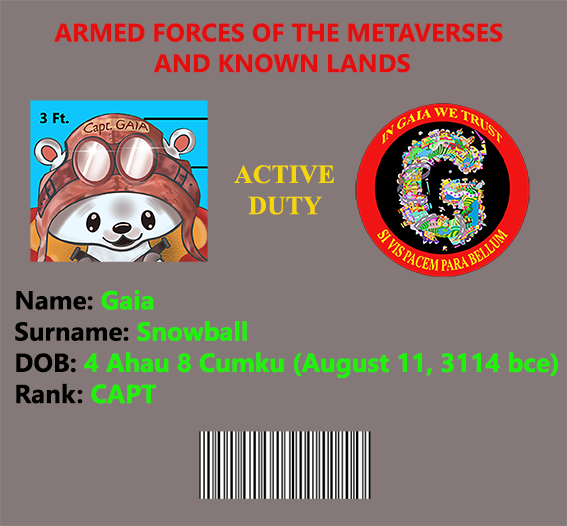
Today we are dealing with Captain Gaia himself. Our hero achieved such fame thanks to his courage and strategic and warlike abilities that the motto “In Gaia We Trust” was coined.
Visitors from other worlds who did not know who our brave warrior was believed that the slogan referred to the goddess Gaia, who was worshiped and whose cult had spread beyond Earth.
As for our brave polar bear cub, no one knows when he was born. After endless seasons of bitter fighting spanning countless metaverses and timelines, the world lost track of time as we know it today.
Thanks to Prime Minister Lovelock's calculations, it was established that Planet Earth, but not other worlds in the Milky Way and others nearby, had entered the Novacene age, although it could not be determined the year of the new age.
In the absence of records of Gregorian calendars - introduced in October 1582 by Pope Gregory XIII - due to the destruction and desolation of the endless wars waged in recent times, the axis of evil, now in power in many metaverses and times and in part of the planet earth, decided to use the Mayan calendar as a new way of counting time.
There were also no records of births that occurred in the last thousands of years, so a Solomonic decision was made: all those living beings whose date of birth was not known would appear by default as born on the date of the creation of the world according to the Mayan calendar: 4 Ahau 8 Cumku, that is, August 11, 3114 B.C.
Interesting Facts: The Maya civilization, which existed in Central America and parts of Mexico from about 2000 BC to 1500 AD, had a sophisticated system of calendars to keep track of time. The Maya had two main calendars: the Haab, which was a solar calendar with 365 days, and the Tzolk'in, which was a sacred calendar with 260 days. The Haab was divided into 18 months of 20 days each, plus an additional period of 5 "unlucky" days at the end of the year. The Tzolk'in was divided into 20 periods of 13 days each. The Maya also had a Long Count calendar, which was used to track longer periods of time, such as the length of a ruler's reign or the time between historical events. The Long Count calendar starts at a mythical creation date and consists of a series of cycles, with the largest cycle lasting about 5,125 years. The Maya used these calendars to keep track of important astronomical events, such as eclipses and the movements of the planets, and for religious rituals and ceremonies.